
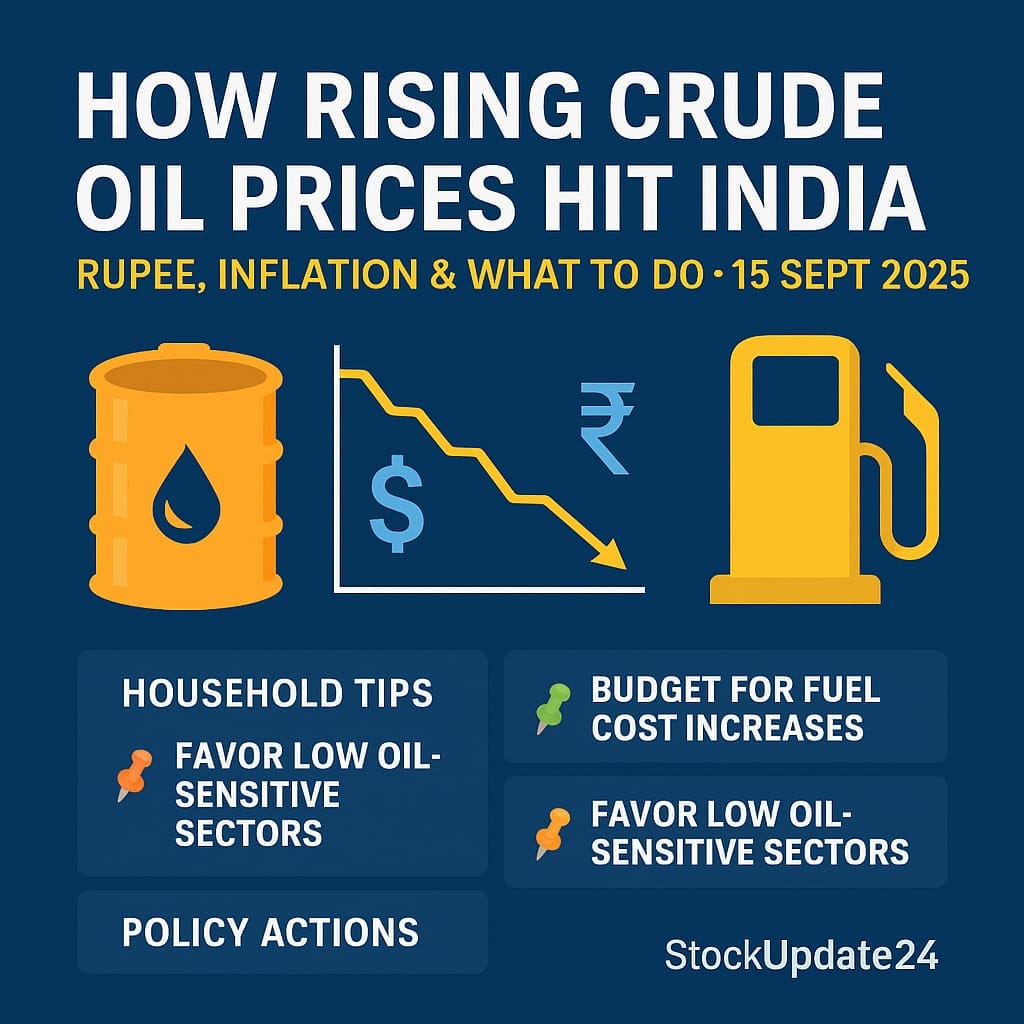
India imports roughly 75–85% of its crude oil requirements. When Brent or WTI rise, India needs more dollars to pay for the same barrels — that raises demand for USD and puts downward pressure on the rupee. For a price-sensitive economy, the effect is fast: fuel prices rise, transport costs jump, and inflation eats into household budgets.
🌍 Global triggers behind the recent spike
- Geopolitical tensions in major producing regions have reduced supply buffers.
- Strong global demand recovery, especially from Asia, tightened markets.
- U.S. dollar strength amplifies the rupee impact because crude trades in USD.
🇮🇳 Direct impacts on the Indian economy
| Area | Effect |
|---|---|
| Fuel Prices | Petrol, diesel, cooking gas prices rise — immediate pain for consumers. |
| Inflation (CPI) | Transport & logistics costs push food and services inflation higher. |
| Rupee & Trade Deficit | Larger import bill → more USD demand → rupee depreciation pressure. |
| Government Finances | Higher subsidy burden or increased excise/tax tweaks may be needed. |
🔍 Policy responses — what can be done
- RBI: Use forex reserves, NDF interventions to support the rupee short-term.
- Govt: Targeted subsidies for vulnerable groups; tactical tax/excise adjustments to control pump prices.
- Longer term: Push for renewables, EV adoption and fuel diversification to reduce import dependence.
💡 Practical tips for households & investors
- Households: Budget for higher transport/energy spend; prefer fuel-efficient commuting or public transport.
- Investors: Favor sectors with low oil sensitivity — IT services, certain FMCG staples, and domestic services.
- Exporters: Use hedges to protect margins; review forex invoicing strategies.
- Firms: Negotiate fuel surcharges transparently with customers or suppliers where possible.
📊 Quick snapshot — what to watch this week
- Daily Brent movement & OPEC statements
- Rupee levels: watch key thresholds (example zone ₹87–₹90 per USD)
- Fuel price revision dates (state & central adjustments)
✅ Conclusion
Rising crude is a macro shock that filters quickly into everyday life in India. Short-term relief depends on RBI and fiscal buffers, but sustainable resilience will come from energy diversification and efficiency. For now — plan, hedge, and prioritise essential spending.
❓ FAQs
- Q: Why does a weak rupee make oil more expensive?
A: Oil is invoiced in USD — if the rupee falls, you need more rupees to buy the same dollar amount of oil. - Q: Will petrol/diesel price rise immediately for consumers?
A: In most cases yes — state & central taxes may delay or temper changes, but pump prices generally follow global crude with a lag. - Q: How can small businesses cope with rising fuel costs?
A: Increase operational efficiency, re-negotiate logistics contracts, and pass through costs carefully to customers where feasible.